
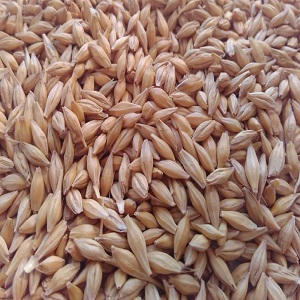
Barley (Hordeum vulgare L.) is one of the main cereal crops. With 150 million tons produced in 2009, barley grain production ranked fourth behind maize, rice and wheat (FAO, 2011). Developing countries account for about 25% of the total barley harvested area (Akar et al., 2003).
Barley is an annual, erect and tufted grass, up to 50 to 120 cm high. It has a strong fibrous root system, with seminal roots that grow as deep as 1.8-2.1 m and anchor the plant, and adventitious roots that explore the upper soil for moisture and nutrients (Ecocrop, 2011; UC SAREP, 2006). The stems are made of 5 to 7 hollow, cylindrical internodes. The leaves are linear and lanceolate, up to 25 cm long, placed opposite their neighbours along the stem (Ecocrop, 2011; Duke, 1983). In barley, the sheaths, ligule and auricles of the leaves surround the stem (Ecocrop, 2011). Spikes are variable in size (short or long) and shape (lax or compact). They may also be awned or awnletted or awnless; they are borne at the end of the culms. Depending on barley type, 1 or 3 spikelets are alternately borne at each node along the rachis of the spike. In domesticated barley, all spikelets are fertile: depending on the number of spikelets, there are barleys with 2 or 6 rows of grains (Cecarelli et al., 2006). Barley grain is an ellipsoid, grooved, 0.7-0.9 cm long caryopse that may be white, blue or black in colour and hairy at the end (Ecocrop, 2011; Duke, 1983).
1 review for Feed Barley
Add a review
Related products

Fish Products
Uncategorized
Uncategorized
Metal Scrap
Metal Scrap
Uncategorized
Uncategorized
Uncategorized

Admin –
Premium Grade AAA